HexClad Lawsuit: What Happened, Settlement, PFAS Claims & What Consumers Should Know
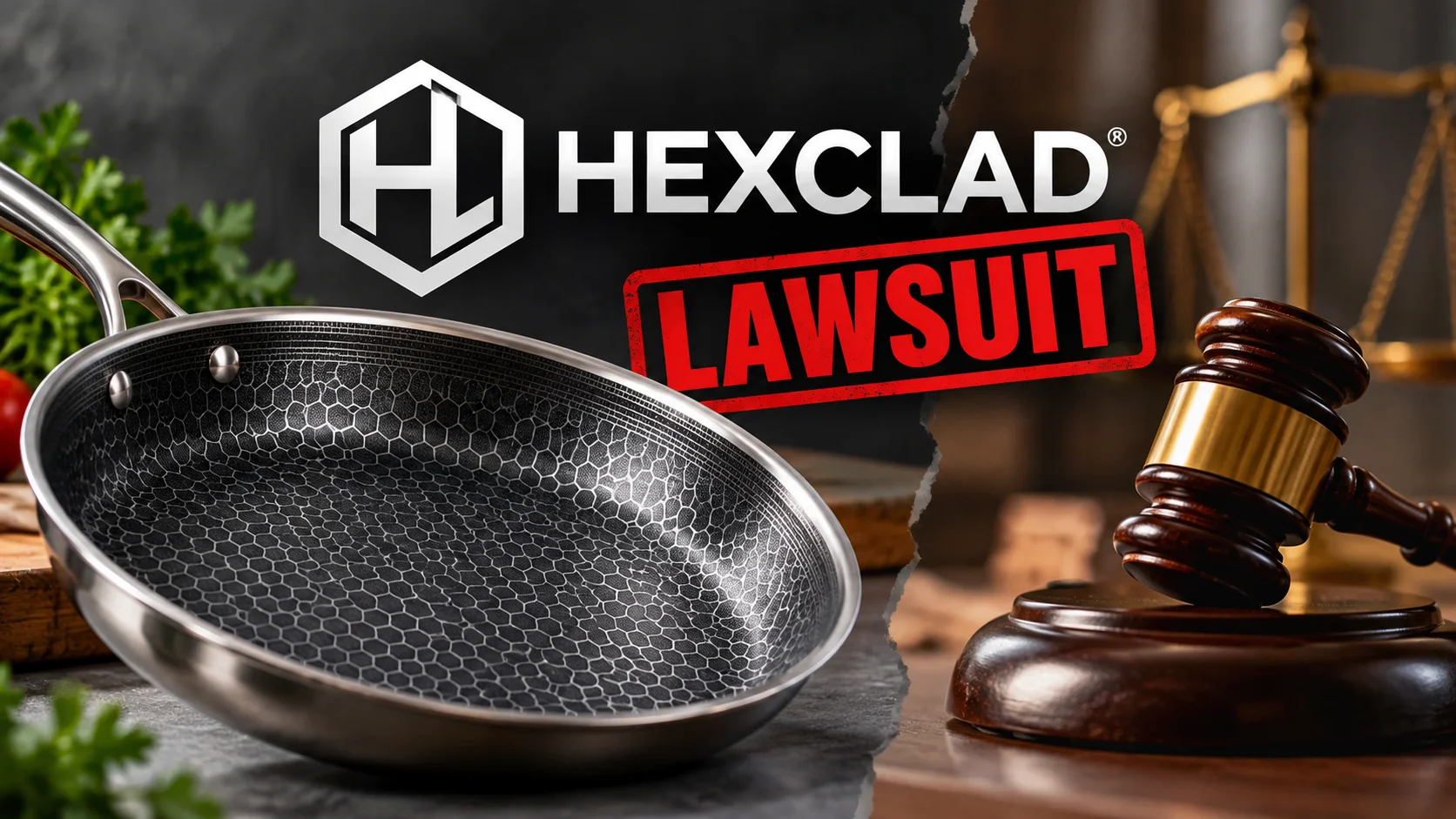
If you’ve been following the news about the HexClad lawsuit, you’ve likely heard about the allegations that the popular cookware brand falsely advertised some of its products as “PFAS-free,” “PFOA-free,” and “non-toxic.” The case drew attention because HexClad previously sold cookware with a nonstick surface coated in PTFE. Still, others claimed the company misled them into believing it was coated with a different material.
Eventually, the courts approved a $2.5 million class-action settlement in March 2026. As part of the settlement, HexClad has not admitted to any wrongdoing or liability.
What happened, what the lawsuit claimed, and how it affects HexClad customers, everything you need to know is here.
Why Was HexClad Sued?
Two related class-action lawsuits were brought against HexClad.
- The federal lawsuit, Didwania v. HexClad Cookware, Inc., was filed in June, 2023. Plaintiffs alleged that HexClad deceptively marketed its cookware as environmentally friendly and free of harmful chemicals while using a PTFE nonstick coating, a type of PFAS.
- A second lawsuit, Cliburn v. HexClad Cookware, LLC (filed as One Source to Market, LLC), is a California state court case filed in November 2023.
That case similarly challenged claims that certain HexClad Hybrid cookware was “non-toxic,” “PFAS Free,” and “PFOA Free.” The plaintiffs claimed violations of California consumer-protection and warranty laws, among others.
Like the Nightfall Group lawsuit, this case also shows how legal disputes can develop around allegations involving business practices and regulatory compliance.
What Did Consumers Allegedly Find Misleading?
The main point of contention was the distinction between PFOA-free and PFAS-free. The lawsuits alleged that HexClad’s prior cookware included PTFE, but was sold with “consumer claims [that] could be interpreted to mean that the cookware was free from PFAS in general.”
Plaintiffs described the alleged marketing as misleading or “greenwashing” and are seeking monetary damages and limits on the company’s marketing.
What Was HexClad’s Response?
HexClad refuted the claims and said that its products met relevant safety requirements. The company also disputed the suit, claiming it was not settling because of its “business judgment” and had no reason to believe the suit had merit. The settlement contains no admission of liability by HexClad.
This matters because a settlement is not equivalent to a court verdict that the company’s products were unsafe or that HexClad intentionally deceived consumers.
The $2.5 Million HexClad Settlement
The California litigation eventually led to a $2.5 million settlement fund. The court gave preliminary approval on April 22, 2025, and final approval on March 9, 2026.
The settlement provided eligible purchasers with a prorated cash refund, depending on the purchase price limit. Other marketing changes were also needed for products made with cookware that included PTFE or other PFAS.
The claims period is from February 1, 2022, to March 31, 2024, and claims will be accepted until November 14, 2025. Consumers who didn’t file a claim before the claims period ends should not assume they can file a claim now.
HexClad Lawsuit Timeline
The federal government brought the class action. A California Cliburn lawsuit was filed on November 17, 2023. The court preliminarily approved a $2.5 million settlement.
On March 9, 2026, the District finally approved the settlement. On March 9, 2026, the District approved the settlement. From May 21, 2026, the settlement administrator will begin distributing payments.
Does the HexClad Lawsuit Mean the Pans Are Unsafe?
The lawsuit did not allege that HexClad cookware was inherently dangerous; rather, it was based on claims that it was marketed and labeled as such. Existing literature suggests PTFE-coated surfaces are acceptable for standard cooking if used as recommended.
However, consumers should continue following cookware temperature and use instructions; overheating can become a separate problem. The settlement did not find that HexClad pans caused consumer injuries or that they could not be sold.
What About HexClad’s NEW Cookware?
HexClad has taken a step toward another coating technology. It has a newer ceramic coating called TerraBond, which it claims is PTFE- and PFAS-free. Products mainly involved in the litigation were the older PTFE-coated products.
Consumers will have to figure out how to tell the difference between the older cookware involved in the litigation and newer cookware with the company’s new coating technology.
What does the Lawsuit Mean for Consumers?
The most important lesson to be learned is that “PFOA-free” does not mean “PFAS-free.” When looking for nonstick cookware, consumers should take the time to check the coating details and any marketing claims, not just a blanket “non-toxic” claim.
The case also shows how regulators and plaintiffs are aggressively scrutinizing marketing claims in consumer products, especially those related to chemicals. California’s cookware rules have also made label transparency more critical. Label transparency is even more critical under California’s cookware rules.
FAQs
Is HexClad being sued?
HexClad faced related class-action litigation over alleged misleading marketing claims about PFAS, PFOA, and “non-toxic” marketing. The initial California lawsuit led to a $2.5 million settlement, which was finally approved in March 2026.
Did HexClad admit wrongdoing?
The settlement was not an admission of liability, and HexClad denied the allegations.
How much was the HexClad settlement?
The settlement established a $2.5-million fund for eligible consumers, paid out pro rata.
Are HexClad pans banned?
The lawsuit and settlement did not ban HexClad cookware. The main disagreement related to marketing and labeling messages.
Is new HexClad cookware PFAS-free?
HexClad’s newer TerraBond ceramic coating is sold as PFAS-free and PTFE-free.
Conclusion
In the lawsuit, HexClad products were accused of being sold in ways that consumers might misread as PFAS-free, despite their use of a PTFE coating.
HexClad admits no guilt, but accepted a $2.5 million fine and agreed to reform some of its marketing practices. The settlement did not find that HexClad’s cookware was unsafe, nor did it find that HexClad admitted liability, just that it finally agreed.
The most important point for consumers is to pay attention to general market buzz and dig into the specific coating technology and chemical claims on the cookware you’re interested in.