Venmo Class Action Lawsuit: Everything You Need to Know

If you’re from the United States or otherwise, you’re probably familiar with Venmo. Millions use Venmo to make transactions every day.
But as Venmo has been quickly growing in popularity, so have its legal troubles. For the past ten years, consumers and regulators have raised concerns about the company’s misrepresentation of fraud protection, privacy settings, and some account issues.
These concerns have prompted government actions and lawsuits, leading many users to question whether there may be a Venmo class action. This article discusses all you need to know about Venmo lawsuits.
Why Has Venmo Been Sued?
Venmo is the subject of most of the legal challenges filed against it, primarily to protect consumers. Consumer-focused legal disputes are not limited to payment platforms, as cases such as the Isotonix Lawsuit have also raised questions about business practices and consumer claims.
In the lawsuit, plaintiffs have claimed that Venmo negligently failed to provide sufficient disclosures about several issues, including:
- Fraud protection
- Unauthorized transactions
- Privacy settings
- Account freezes
- Transfer delays
- Purchase Protection coverage
- Data collection practices
- Fee disclosures
While some lawsuits have been filed, most have been settled by the government rather than through a class action settlement.
Timeline of Major Venmo Lawsuits and Investigations
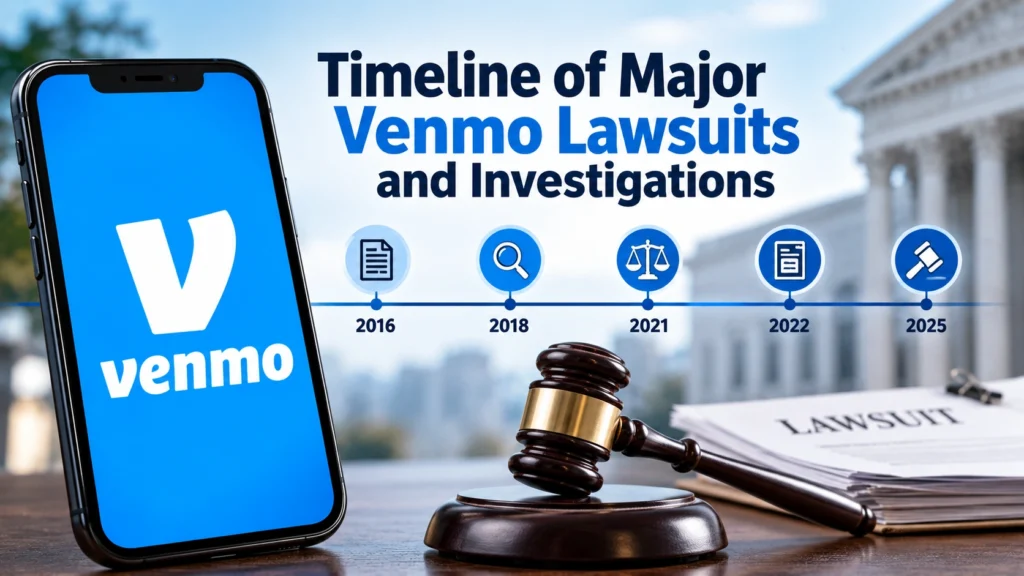
There have been a few key court events that have influenced Venmo’s legal history.
2016 – Texas Privacy Investigation
Venmo faces allegations of failing to give users enough notice and was the subject of an investigation by the Texas Attorney General.
The investigation led to a settlement requiring Venmo to enhance privacy disclosures and halt undisclosed data collection. The company also was fined a civil penalty of some $175,000.
2018 – FTC Enforcement Action
One of the biggest enforcement actions was by the Federal Trade Commission (FTC).
The FTC alleged that Venmo:
Misrepresented the amount of time it took to get money transferred into an account
Led users to believe that their accounts were secure when they weren’t.
Did not correctly explain Privacy settings
In some cases, scholarships were made public, allowing private transactions to become public.
PayPal (Venmo’s parent company) decided not to pay monetary sanctions; instead, PayPal agreed to make extensive enhancements to disclosures, privacy policies, and compliance monitoring.
Plaid Data Privacy Settlement – 2021
While the Plaid class action settlement was not directly targeted toward Venmo, many Venmo users were involved. Plaid settled allegations of unlawfully obtaining consumers’ banking information for $58 million.
That settlement offered some Venmo users compensation, as it should have those who had connected their bank accounts via Plaid. Consumer protection disputes can take many forms, as seen in cases such as the Pima County Sheriff Lawsuit, where legal claims also brought public attention to alleged rights violations.”
2022 – Al-Ramahi v. PayPal
One of the early proposed Venmo consumer class actions was filed in Federal Court in June of 2022.
According to the lawsuit, Venmo did not honor federal consumer protection laws by not reimbursing victims of unauthorized and/or fraudulent transfers.
But the plaintiff did not get a class certification or settlement until September 2022, when he withdrew from the case.
This is a Hawaii Consumer Protection Lawsuit from 2022 – 2025
The Office of Consumer Protection of Hawaii filed a lawsuit against PayPal for allegedly engaging in deceptive practices relating to Venmo.
The lawsuit alleged the company was deceptive in its statements about:
Purchase Protection
Privacy controls
Access to funds
Fraud protection
PayPal will pay $6 million to settle the case in December 2025, but will not admit fault.
Importantly, the settlement money went to the State of Hawaii – not the individual consumers.
2025 – New Hampshire Settlement
New Hampshire’s Attorney General has also settled with PayPal on Venmo’s practices.
The agreement required:
Improved fraud warnings
More detailed and informative descriptions of privacy settings.
Better disclosure of access to users’ funds
PayPal will pay a $1.75 million penalty, but not admit liability. Again, no direct Venmo users made payments.
The Al-Ramahi Venmo Class Action Explained
The lawsuit against PayPal by Al-Ramahi was not a “Venmo class action lawsuit”—other cases were brought to the class certification phase, and none were brought to that point for this case.
The Plaintiff’s Allegations
The plaintiff alleged that he had been defrauded out of some $2,450 by a man who pretended to be his employer.
In the grievance, it was alleged that:
Venmo claimed it’s safe and secure.
The firm was very aware that there was extensive fraud on the platform.
There was a regular practice of denying victims reimbursement.
There was insufficient warning of the risk of scams to consumers.
Venmo’s policies have breached federal consumer protection laws, the suit said, and it was misleading users about their rights after a fraud took place.
The legal issues that have been brought against Venmo include a few of the following:
Several cases and investigations have been based on various theories of law.
This is an agreement to transfer funds electronically, as called for in the Electronic Funds Transfer Act
There were numerous claims that Venmo, a method of electronic funds transfers, infringed on the Electronic Funds Transfer Act (EFTA) and Regulation E.
The laws usually mandate that financial institutions investigate unauthorised electronic transfers and reimburse the consumer in certain situations.
The main question is whether payments made by users who scammers deceived should be considered “unauthorized” under federal law.
Many fraudulent payments made on Venmo are valid for several reasons, including that the customer actually made them, even if they were misled.
Consumer Protection Laws
Several lawsuits have been based on state consumer protection statutes.
Venmo was accused of committing deceptive business practices for its:
- Overstating fraud protection
- Misrepresenting Purchase Protection
- Giving false assurances on privacy/policies
- Not providing sufficient sanitation information about the account;
- Negligence
There are several complaints that Venmo should have taken reasonable precautions against fraud.
According to Plaintiffs, the company:
Failed to safeguard against fraud effectively
Did not thoroughly investigate complaints
Permitted illegal transactions to go through when there were red flags present
Breach of Contract
Consumers have also claimed that Venmo breached its terms and conditions as outlined in its own user agreement, which issued guarantees about the dispute procedure and account services.
Unjust Enrichment
There have been multiple lawsuits alleging that Venmo profited from consumers’ losses due to fraud and frozen accounts, and consumers incurred costs in fees.
Privacy Concerns
One of the major controversies regarding Venmo has always been privacy.
Venmo is unlike other payment networks where transactions are hidden by default; it actually made a point of making them public.
The amount of payment transactions was hidden, but the payment description, username, and payment activity were often visible to other users.
Regulators argued that:
Privacy controls were confusing.
Users misunderstood default settings.
Previously private transactions could become visible under certain circumstances.
Marketing claims exaggerated measures for user privacy.
This was a significant aspect of the FTC enforcement action.
The Bigger Picture
The spotlight on Venmo also highlights the broader issues of consumer protection in the rapidly growing fintech sector. Peer-to-peer payment systems are regulated differently than traditional banks, leading to ongoing disputes over fraud liability and privacy issues.
As of 2026, Venmo has not faced a major class action, but federal and state investigations have led to key changes in its policies and disclosures. These regulatory initiatives have also influenced broader efforts to strengthen oversight of digital payment services.
Venmo’s legal history serves as a warning for users, particularly as regulators investigate payment apps and lawmakers push for stronger consumer protections.